· AI dev tools
Signal blocks AI agents like Gemini, Siri, from accessing messages to protect privacy
The encrypted messaging application Signal has implemented safeguards preventing AI agents like Google Gemini and Apple Siri from viewing messages unless the user grants explicit permission, a move…
The encrypted messaging application Signal has implemented safeguards preventing AI agents like Google Gemini and Apple Siri from viewing messages unless the user grants explicit permission, a move driven by pressing privacy concerns.
Signal CEO Meredith Whittaker stated that these protective measures became necessary, mirroring a screenshot blocking feature introduced last year to combat Microsoft Recall, to stop agentic software present in both Android and iOS from gaining access to private communications.
In a blog post, Whittaker noted that "Google and Apple are integrating agentic capabilities like Gemini Intelligence with Google Gemini and Onscreen Awareness with Siri AI deep into their operating systems." She further explained that these OS-level AI agents "scan" information displayed on the screen to gain knowledge about the user, resulting in Signal data being captured and subsequently made available to these agentic systems so they can fulfill requests and answer queries.
The consequence of this data ingestion by these automated systems is that private messages could potentially end up on an external server, thereby losing their intended privacy.
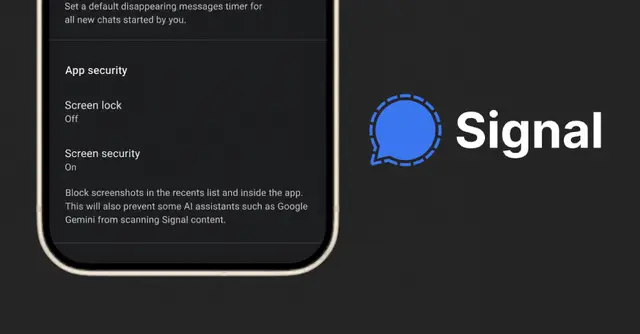
Updates to both the iOS and Android versions of Signal now incorporate controls that, by default, prevent Siri on iOS and Gemini along with other agents on Android from capturing screenshots, which AI agents then analyze using optical character recognition to pull out text.
While Whittaker acknowledges that users can deactivate this protection within Signal's settings if they wish to take screenshots of their messages, she issues a caution that doing so risks exposing both their own Signal content and messages sent by their contacts to AI agents.
Furthermore, Whittaker admits that screenshot blocking is only a partial defense, because AI agents might employ alternative avenues to access application data through the device's file structure. She made it clear, stating, "We want to be very clear: it is a serious problem that Signal – and application developers beyond – lack robust tools to prevent AI agents from undermining application-level privacy."
She added that even when Signal is able to detect and block AI data access, "Google, Apple, Microsoft, and others do not provide ways for developers to easily restrict such AI data access without making drastic compromises to the core user experience." This difficulty is also cited as the reason why these protections are not yet available on macOS.
Apple is making some efforts to build defenses against prying AI agents on macOS, though this appears primarily aimed at restricting third-party access rather than limiting its own Siri functionality. Siri itself can be disabled independently.
With the release of macOS 27.3, which is currently in public beta testing, Apple's desktop operating system will introduce more detailed controls over two specific APIs: Device Control and Data Access, alongside Full Disk Access. This change will lead to more frequent permission requests for macOS applications seeking access to user data, alongside the added complexity of applying for an entitlement from Apple to secure Full Disk Access for backup software and assistive technologies utilizing Accessibility APIs.
Apple announced the Full Disk Access modification by stating, "As AI agents become increasingly capable and autonomous, the risks associated with this level of access will grow substantially." The company further committed that "We are committed to ensuring users clearly understand these risks before granting such access, so they can make informed decisions about their own data and privacy."
Reportedly, Apple is also developing its own AI agent as part of its strategy to compete against entities such as Anthropic and OpenAI. Whether Apple will leverage its control over its operating system as a competitive advantage against AI firms that challenge its gatekeeping role, similar to how it has done with web browsers, remains to be determined.
The emergence of barriers, such as Signal blocking Siri, demonstrates that AI agents introduce complexities into trust decisions and the competitive environment, even as Apple positions itself as an ally defending device users from intrusive AI agents.
AI agents are intended to benefit the user, but when they siphon data to the cloud and insert themselves between consumers and vendors, their appeal diminishes. These agents also present a threat to the ongoing commercial relationship between shoppers and sellers.
Various entities have erected similar limitations or safeguards against third-party AI agents; for example, Amazon has restricted shopping agents like Meta Muse from its e-commerce platform (though not from AWS Marketplace), while Walmart has opened its AI Gateway for third-party agent interaction. Anthropic has barred subscription customers from utilizing outside harnesses, and United Airlines has prohibited transactions originating from unauthorized AI bots.
Other companies implementing similar restrictions include Target, Home Depot, Etsy, eBay, JPMorgan Chase, Charles Schwab, Citigroup, and Wells Fargo. Simultaneously, a growing industry focused on detecting and mitigating bots is developing, spearheaded by companies such as Cloudflare, Akamai, and DataDome.
The concept of a web browser being a "user agent," based on the ideal that it serves its user, has been complicated by online data collection and advertising, as well as default settings that often benefit the browser creators rather than protecting privacy. Now, AI agents face comparable scrutiny as people question whether their respective agents are genuinely serving them or serving someone else.
Following a period where agent providers argued for unrestricted access to all digital data in the name of personalization and context, a wave of pushback has now arrived.
Why it matters
This development highlights a critical gap in developer tooling, as Signal notes a lack of robust ways to prevent AI agents from undermining application-level privacy. Developers should watch how operating systems balance AI capabilities with the need for granular data access controls.